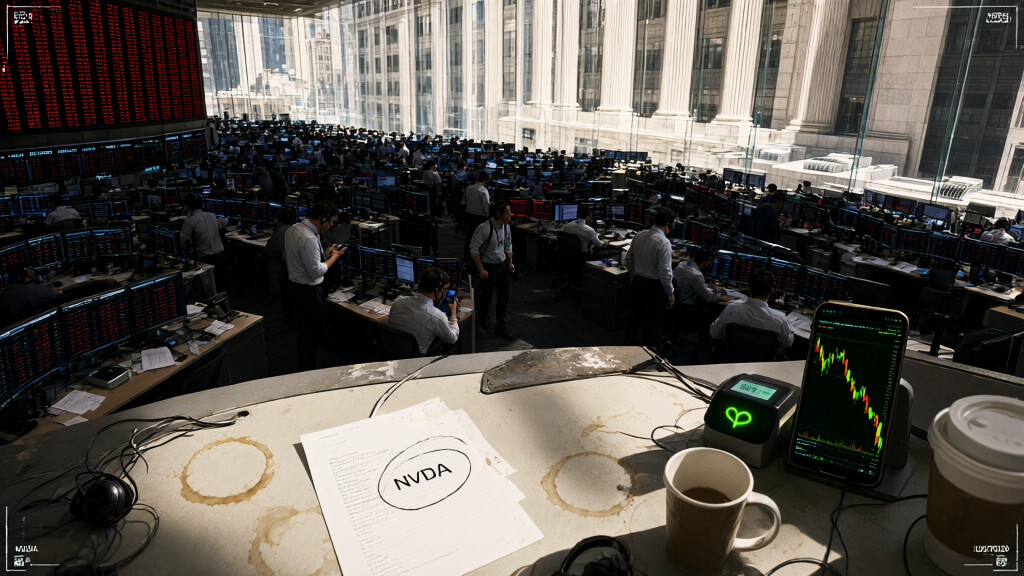
NEW YORK. A newly arrived reader should learn early that on Terra a company's price is not its worth. It is the running average of everyone's feelings about the worth, recalculated continuously, and the average does not wait for the worth to make up its mind. On November 13, 2026, wire services including ANSA reported that Jensen Huang, chief executive of the chipmaker Nvidia, had thrown in the sponge — the local idiom for publicly abandoning hope — and that Nvidia shares fell on Wall Street in response. Note the order of operations: the institution licensed to store the numbers repriced the company before Huang's own organisation had issued any paperwork confirming the hope was gone.
The custom is called trading on sentiment. The chief executive speaks; machines owned by investors listen; the machines do not wait for meaning, they measure hesitation, cadence, and the length of pauses. "We never trade the statement," a portfolio manager named Gary Pell, who oversees several billion units of other people's caution, told this desk. "We trade the eleven seconds before he finishes the sentence. The last four words are for the newspapers."
What the exchange did in moments, the company's own communications apparatus took most of a working day to authorise. "The guidance is directional," explained Roberta Vance, Senior Director of Shareholder Confidence, serenely. "The doubt was anticipated, pre-modelled, and partially priced in advance. In a sense the sell-off confirms our guidance worked." She then thanked this desk for its interest and wished it a pleasant rest of its orbit.
The measured gap, in the standard notation of this bureau: declaration of surrender, 13 November, morning; Wall Street repricing, same session; corporate confirmation of the surrender, later. The market knew the doubt a working day plus lunch before the doubter's employer admitted the doubter had doubted. For calibration: the money moved through fibre optics at nearly lightspeed, while the cause of the money moving travelled at the speed of one man talking.
This correspondent logs such discrepancies as timing credits; our own dispatches have arrived before their incidents and the arithmetic has never once apologised. Which returns us to the opening lesson, now with figures attached: the price is the average of the feelings, the feelings beat the facts to the wire, and the facts, upon arrival, are invoiced for the delay. Filed below, one row: doubt, unit quantity one, resold to its original owner, same afternoon, at market rate.